12 Best Cloud Cost Optimization Tools for FinOps Teams in 2025
Cloud spending can quickly spiral out of control, turning a powerful asset into a significant financial drain. As engineering and FinOps teams face pressure to innovate while controlling budgets, finding the right tooling is no longer a luxury; it's essential for survival. The challenge lies in navigating a crowded market where every platform promises massive savings but often delivers complexity. Without the right solution, teams waste countless hours manually tracking expenses, identifying idle resources, and trying to forecast future costs, all while the bill continues to grow. This inefficiency directly impacts the bottom line and slows down development cycles.
Ready to slash your cloud bill? Server Scheduler offers a simple, no-code solution to automate stopping and resizing idle AWS resources. Start saving up to 70% today!
This guide cuts through the noise, offering a detailed comparison of the best cloud cost optimization tools available. It's a curated roundup for DevOps engineers, FinOps teams, and IT managers who need to make an informed decision without sifting through marketing jargon. We will explore everything from native cloud provider tools to specialized third-party platforms. To better understand various strategies for cost saving, you may find related content helpful before diving into the specific tools that implement them. Our goal is to equip you with the insights needed to transform your cloud cost management from a reactive chore into a proactive, strategic advantage.
Contents
- 1. Server Scheduler
- 2. AWS Marketplace – Cost Optimization solutions catalog
- 3. Microsoft Cost Management (Azure native)
- 4. Google Cloud Cost Management and FinOps Hub
- 5. IBM Apptio Cloudability
- 6. CloudZero
- 7. CAST AI
- 8. Kubecost
- 9. ProsperOps
- 10. nOps
- 11. Harness Cloud Cost Management (CCM)
- 12. Flexera One – Cloud Cost Optimization
- Making the Right Choice for Your Cloud Environment
- Related Articles
Ready to Slash Your AWS Costs?
Stop paying for idle resources. Server Scheduler automatically turns off your non-production servers when you're not using them.
1. Server Scheduler
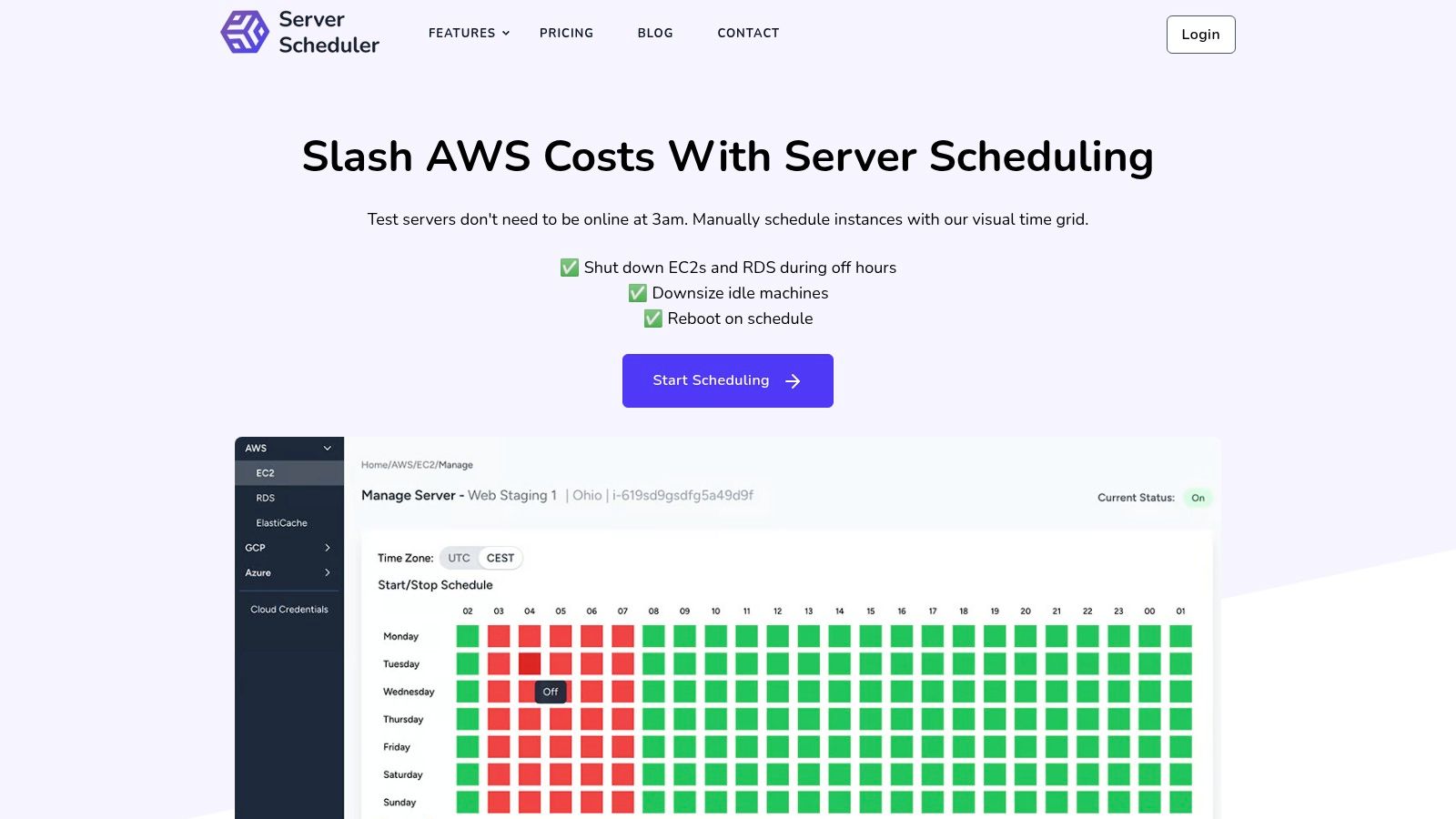
Server Scheduler distinguishes itself as one of the best cloud cost optimization tools by focusing on simplicity and direct impact. It provides an elegant, no-code solution for a common source of cloud waste: idle non-production resources. Rather than requiring complex scripts or infrastructure-as-code modifications, it offers a visual, point-and-click time grid. This interface allows DevOps, FinOps, and IT teams to effortlessly define start, stop, resize, and reboot schedules for AWS resources like EC2 instances and RDS databases. The platform’s core strength lies in its accessibility and immediate ROI. Teams can quickly implement schedules to power down development, staging, and QA environments during nights and weekends, which the vendor claims can reduce cloud bills by up to 70%. Its ability to schedule resizes offers a more granular level of control, allowing users to scale down instances during low-traffic periods without shutting them down completely. For a deeper dive into this functionality, you can explore their guide on building a powerful EC2 instance scheduler on serverscheduler.com.
2. AWS Marketplace – Cost Optimization solutions catalog
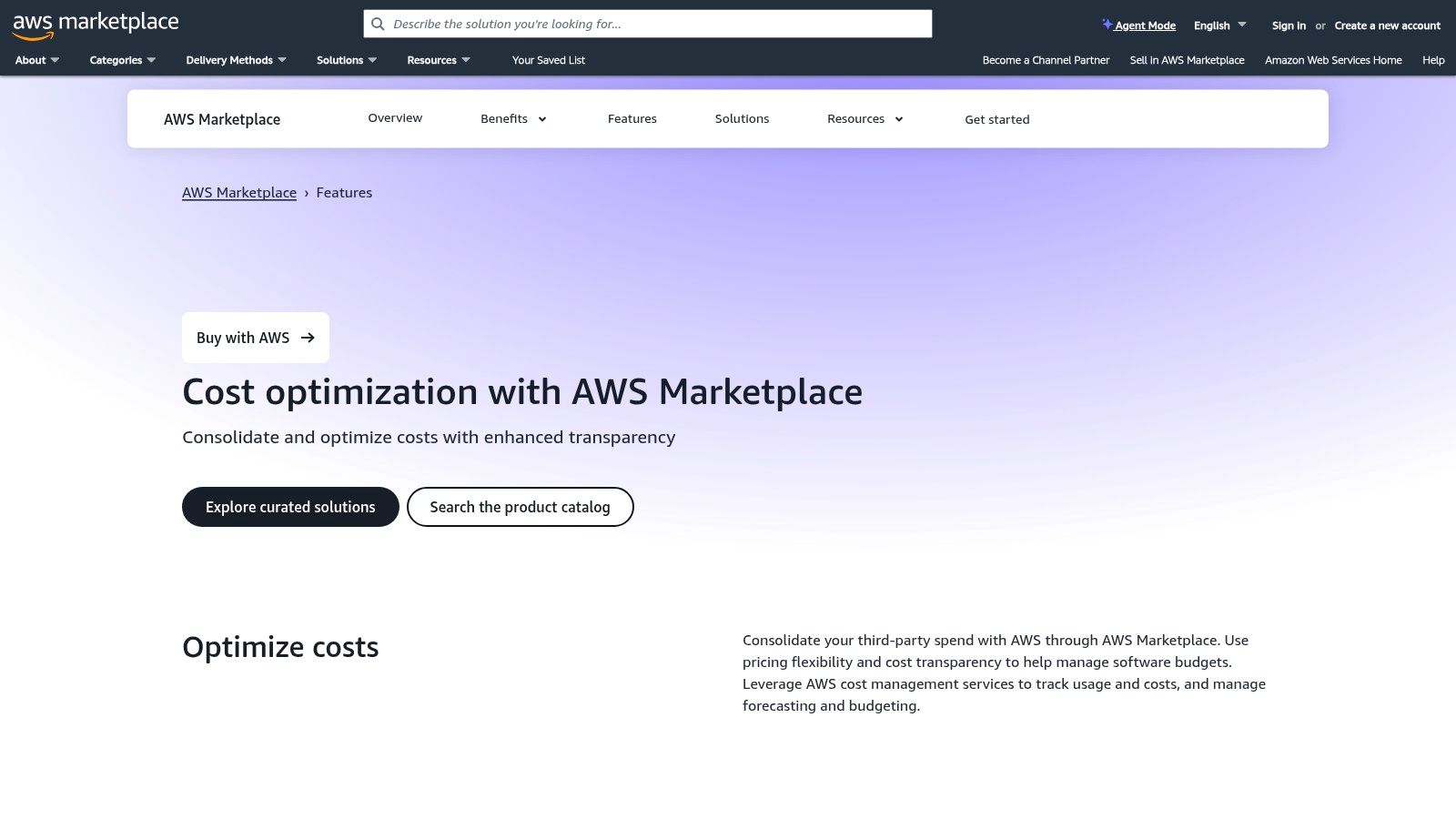
For organizations deeply embedded in the AWS ecosystem, the most straightforward path to acquiring cost management tools is often through the AWS Marketplace. This isn't a single tool, but a curated digital catalog featuring hundreds of third-party cloud cost optimization tools. Its primary advantage lies in simplifying procurement and billing, allowing you to purchase and deploy solutions from vendors like Cloudability or Harness directly through your existing AWS account. This centralized approach streamlines vendor management, as all charges appear on a single, consolidated AWS bill. For businesses with an AWS Enterprise Discount Program (EDP), purchasing through the Marketplace is a significant benefit, as the spend on these third-party tools can often count toward fulfilling those commitments. By leveraging this platform, you can enhance your financial operations with powerful tools while following established AWS cost optimization best practices.
| Feature Analysis | Assessment |
|---|---|
| Procurement Model | Excellent: Simplifies purchasing by integrating with existing AWS billing and procurement workflows. |
| Multi-Cloud Support | Poor: Primarily focused on solutions for the AWS ecosystem, with limited options for other clouds. |
| Tool Selection | Good: Offers a wide variety of vetted cost management and FinOps tools from reputable third-party vendors. |
| Pricing & Flexibility | Very Good: Supports private offers and consolidated billing. Spend can count toward AWS commitments. |
3. Microsoft Cost Management (Azure native)
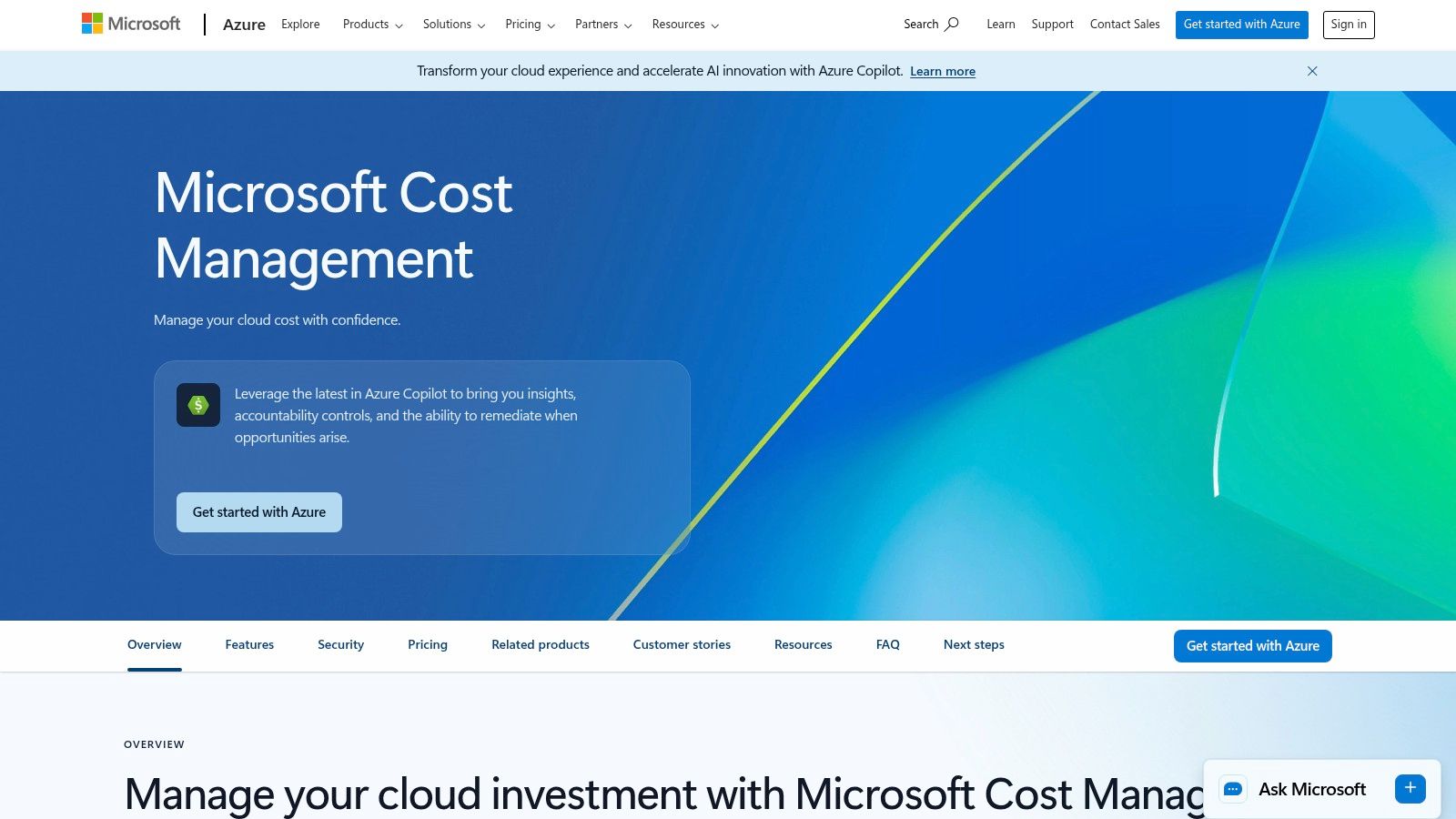
For businesses heavily invested in the Microsoft Azure cloud, the native Microsoft Cost Management tool is the essential starting point. This built-in solution provides comprehensive visibility, accountability, and optimization capabilities directly within the Azure portal at no additional cost. Its core strength lies in its seamless integration with the Azure ecosystem, offering tools for budgeting, cost allocation, and forecasting that are deeply connected to Azure resources. This native integration allows for precise cost analysis tied to subscriptions and resource groups, empowering teams with actionable insights. Features like budgets with alert triggers and AI-powered recommendations help prevent overspending. While focusing on Azure, understanding the broader landscape of Microsoft's cloud offerings, such as O365 Cloud Computing, can also contribute to comprehensive cost optimization strategies. By leveraging this platform, you can apply key cloud cost optimization best practices directly within your Azure environment.
4. Google Cloud Cost Management and FinOps Hub
For organizations operating primarily on Google Cloud Platform (GCP), the native Cost Management and FinOps Hub provides a powerful, integrated suite of tools at no additional charge. It combines cost exploration, budgeting, and alerting with advanced, AI-driven features like anomaly detection to help teams proactively manage their cloud expenses. A standout feature is the FinOps Hub, which acts as a centralized dashboard for optimization. It automatically surfaces opportunities, such as identifying idle resources or recommending Committed Use Discounts (CUDs), and quantifies their potential savings. The hub also generates a "FinOps score," a metric that helps organizations benchmark their cost optimization maturity against GCP best practices. This gamified approach encourages continuous improvement and makes it one of the best cloud cost optimization tools for teams committed to the Google ecosystem.
5. IBM Apptio Cloudability
For large, complex enterprises navigating multi-cloud finance, IBM Apptio Cloudability stands out as an enterprise-grade FinOps platform. It offers a powerful suite of tools designed to provide deep visibility and control over cloud spending across AWS, Azure, and GCP. The platform excels at detailed cost allocation, enabling organizations to map cloud costs accurately to business units, projects, or applications. Cloudability's strength lies in its comprehensive feature set, which includes savings automation for commitment programs, anomaly detection, and robust forecasting. Its business mapping capabilities are particularly valuable for large organizations, providing the context needed to make informed, data-driven decisions. While it provides recommendations, teams must still implement changes, such as learning how to schedule EC2 instance resizing to act on its insights.
6. CloudZero
CloudZero positions itself as a cost intelligence platform, moving beyond simple visibility to provide business-level unit economics. It excels at answering questions like "what is our cost per customer?" or "how much does this specific product feature cost to run?" Its engine normalizes cost data from major clouds, Kubernetes, and even SaaS tools like Snowflake. This makes it one of the best cloud cost optimization tools for organizations that need to map complex cloud spend directly to business value. The platform is built for engineering and product teams, enabling them to understand the cost implications of their architectural decisions. By automatically allocating 100% of spend, including untagged resources, it provides granular visibility into the costs of specific features or teams.
7. CAST AI
For organizations leveraging Kubernetes, CAST AI offers a highly automated approach to cloud cost optimization. It moves beyond simple recommendations by actively managing and rightsizing clusters in real-time. The platform connects to your Kubernetes cluster and, within minutes, provides a free savings report. It then automates instance selection, bin-packing, and autoscaling to ensure workloads run on the most cost-effective compute resources, including Spot Instances, without manual intervention. This focus on automation is what sets CAST AI apart. It continuously analyzes workload requirements and adjusts the underlying infrastructure to match, eliminating over-provisioning. The platform's ability to orchestrate Spot Instances with fallback mechanisms provides significant savings with high availability.
8. Kubecost
For teams running workloads on Kubernetes, gaining granular cost visibility is a specialized challenge. Kubecost addresses this directly by providing real-time cost monitoring and optimization specifically for Kubernetes environments. It integrates deeply into clusters to allocate costs accurately to concepts like namespaces, deployments, or individual pods. Built on an open-core model, Kubecost has become a standard for Kubernetes FinOps. The platform provides actionable recommendations for rightsizing container requests, identifying abandoned workloads, and resizing clusters. Its specialization is also its main limitation; it is not a comprehensive multi-cloud cost management platform. However, its focus is a key part of any effective Kubernetes cost optimization strategy.
9. ProsperOps
ProsperOps takes a unique, automated approach to AWS cost reduction by focusing exclusively on optimizing discount instruments like Savings Plans and Reserved Instances. Instead of providing dashboards for manual analysis, it acts as an "autonomous discount management" service. The platform continuously manages your portfolio of AWS commitments, automatically making adjustments to maximize savings without requiring human intervention. This makes it one of the more hands-off cloud cost optimization tools available. The service is engineered to eliminate the risk and complexity associated with managing long-term AWS commitments. A standout feature is its outcome-based pricing model, where ProsperOps takes a percentage of the actual savings it generates.
10. nOps
nOps is an AWS-centric FinOps platform designed for rapid onboarding and immediate impact on cloud spend. It distinguishes itself with a hybrid pricing model that combines fixed-fee tiers for core visibility features with results-based "Optimize" add-ons. This approach allows teams to access foundational tools while only paying for advanced optimization services when they deliver tangible savings. The platform is available directly through the AWS Marketplace, which streamlines procurement. A unique feature is its GenAI assistant, ShareSave, which helps FinOps teams analyze cost data through natural language queries. Integrations with tools like Slack and Jira ensure that cost-saving recommendations are delivered directly into existing engineering workflows.
11. Harness Cloud Cost Management (CCM)
Harness Cloud Cost Management (CCM) differentiates itself by integrating deep automation and governance directly into its FinOps platform. It offers proactive cost control features designed for engineering and DevOps teams. The platform provides granular cost attribution through "Perspectives," allowing organizations to slice cost data by team, application, or service. One of its standout capabilities is AutoStopping, an intelligent automation feature that shuts down idle, non-production resources and can restart them on demand. This directly targets a common source of cloud waste. Harness also offers AI-powered anomaly detection and commitment orchestration for managing Savings Plans and Reserved Instances effectively.
12. Flexera One – Cloud Cost Optimization
Flexera One stands out by merging cloud cost management (CCM) with deep-rooted IT Asset Management (ITAM) capabilities, making it a powerful choice for large enterprises. This platform is designed for organizations that require stringent, policy-based governance across a complex, hybrid IT landscape. It provides a unified view of costs and usage across AWS, Azure, GCP, and on-premises infrastructure. What makes Flexera One a notable contender is its library of pre-built policies that can trigger automated actions to enforce financial governance. The platform also integrates sustainability metrics, allowing businesses to track and report on the carbon footprint of their cloud usage.
Making the Right Choice for Your Cloud Environment
Navigating the landscape of the best cloud cost optimization tools can feel overwhelming, but the journey to a more efficient and cost-effective cloud environment is achievable. The key takeaway is that there is no single "best" tool for every organization. The right choice hinges entirely on your specific circumstances: the scale of your infrastructure, your team's existing skill set, and the primary drivers of your cloud costs. Before committing to a platform, conduct a thorough internal assessment. Identify where your budget is truly going. Is it underutilized compute instances, oversized databases, or inefficient container orchestration? Answering this question will illuminate the path forward and prevent you from investing in a powerful but mismatched solution. For many businesses, the most significant source of wasted cloud spend is non-production environments left running 24/7. This idle resource waste can account for up to 70% of a development environment's costs. This is why targeted, automated scheduling solutions offer such a compelling return on investment. Instead of embarking on a complex project, teams can achieve immediate and substantial savings by simply turning off what isn't being used. This pragmatic approach delivers a quick win and frees up the budget for more advanced optimization efforts down the line.