12 AWS Cost Optimization Tools You Should Know
Navigating the AWS ecosystem to control spending can feel overwhelming. With a vast array of services and complex pricing models, cloud bills often spiral, consuming significant portions of engineering budgets. The core challenge lies in identifying and eliminating waste without compromising application performance or availability. This is where dedicated AWS cost optimization tools become essential, transforming raw billing data into actionable insights for DevOps engineers, FinOps teams, and IT managers.
Ready to capture one of the easiest and most significant savings opportunities in your AWS account? Server Scheduler specializes in automating the shutdown of non-production environments, helping you stop paying for idle resources. Get started and see immediate savings.
This comprehensive guide is designed to help you cut through the noise. We will explore a curated list of the top platforms and native services that address the most significant drivers of cloud waste. We’ll move beyond generic feature lists to provide a practical analysis of each tool, complete with pros, cons, pricing signals, and ideal use-case scenarios. Before diving into specific tools, it's beneficial to understand broader cloud cost optimization strategies that yield real savings. Understanding these foundational concepts will help you better evaluate which tool aligns with your specific needs.
Contents
- Server Scheduler
- AWS Marketplace (Cost Management/FinOps solutions)
- AWS Cost Explorer
- AWS Compute Optimizer
- Spot by NetApp (now part of Flexera)
- ProsperOps
- Zesty
- IBM Apptio Cloudability
- VMware Aria Cost (powered by CloudHealth)
- nOps
- Harness Cloud Cost Management
- CloudZero
- Choosing the Right Tool for Your Needs
Ready to Slash Your AWS Costs?
Stop paying for idle resources. Server Scheduler automatically turns off your non-production servers when you're not using them.
Server Scheduler
Server Scheduler delivers a refreshingly direct approach to AWS cost optimization. Instead of complex dashboards or deep analytics, it focuses on one of the most effective cost-saving strategies: turning off resources when they are not in use. Its core value proposition is a visual, point-and-click interface that allows DevOps, FinOps, and IT managers to define start, stop, resize, and reboot schedules on a simple time grid. This eliminates the need for cron jobs, custom scripts, or complex Infrastructure as Code (IaC) configurations for basic operational scheduling.
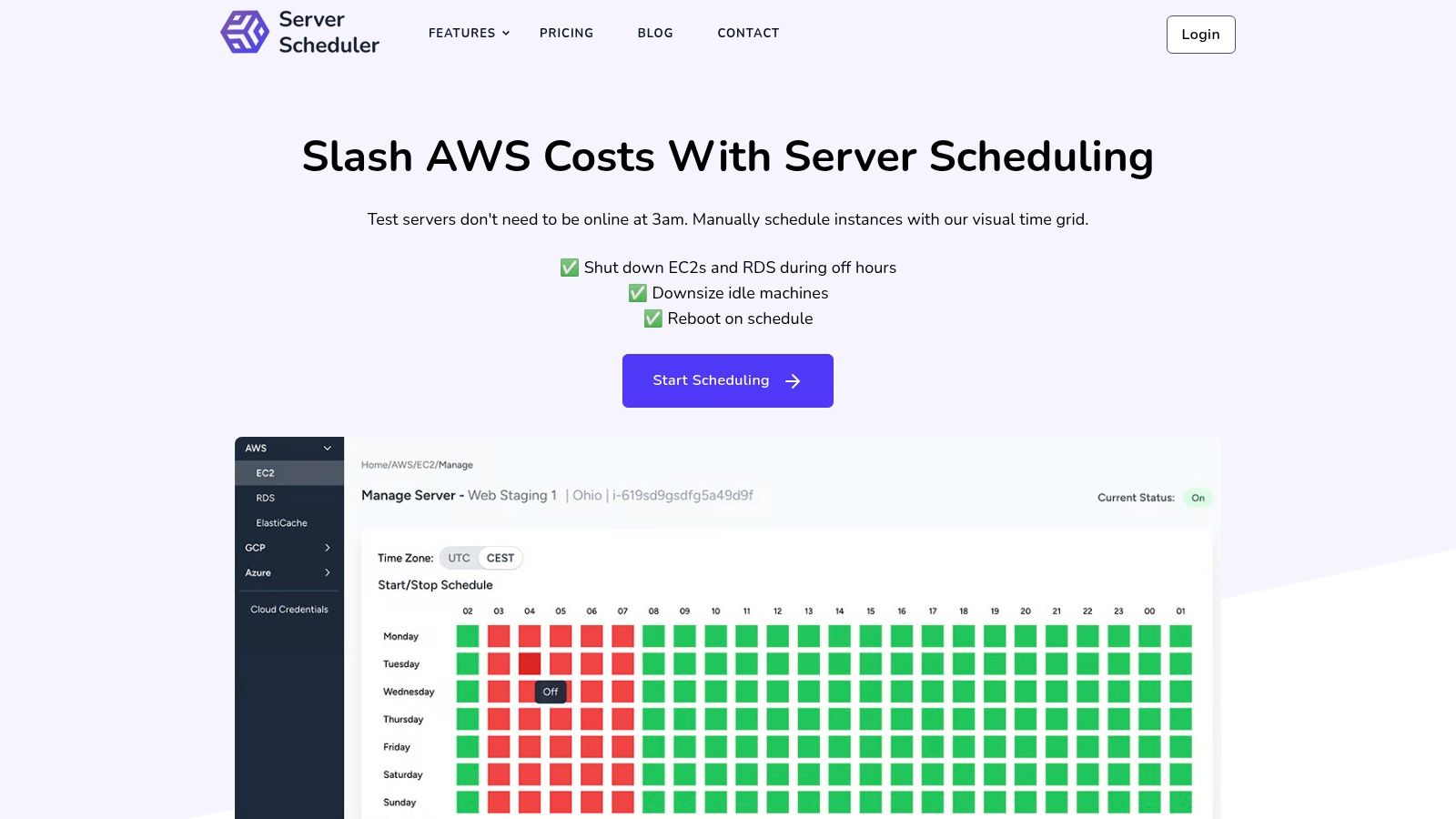
The platform is purpose-built for teams that want quick, substantial wins without adding operational overhead. It's particularly effective for managing non-production environments (development, staging, QA) that often sit idle overnight, on weekends, and during holidays. By automating the shutdown of these instances, organizations can achieve significant cost reductions, with the vendor claiming savings of up to 70%. The inclusion of scheduled resizes also allows for dynamic capacity management, scaling resources up for peak demand and down during lulls. Its simplicity and focus on scheduling make it a standout solution for immediate savings. You can learn more about its specific capabilities by reading how to schedule stop and start EC2 instances on serverscheduler.com.
AWS Marketplace (Cost Management/FinOps solutions)
Instead of a single tool, the AWS Marketplace functions as a curated digital catalog, making it a critical starting point for sourcing third-party AWS cost optimization tools. It simplifies the often-complex procurement process by centralizing discovery, billing, and deployment. For organizations already deeply integrated with AWS, this platform streamlines purchasing by consolidating software charges onto a single AWS invoice and allowing spend to count toward Enterprise Discount Program (EDP) commitments.
The primary advantage is governance. Teams can enforce procurement guardrails, manage software licenses centrally, and leverage private offers for customized pricing and terms directly from vendors. For a broader perspective on leveraging cloud marketplaces for various solutions, including those pertinent to FinOps and cost management, readers may find value in exploring an article on Harnessing Cloud Marketplaces. The marketplace provides a strategic avenue for acquiring specialized tools while maintaining financial control.
| Feature/Aspect | Details |
|---|---|
| Best-Fit Use Case | Teams that need to purchase multiple cost management solutions and want to simplify procurement, consolidate billing, and leverage existing AWS enterprise agreements. |
| Pros | Streamlined Procurement: Software is vetted by AWS, and purchases are integrated into your existing AWS account and billing cycle. Consolidated Billing: A single invoice covers both AWS services and Marketplace software. |
| Cons | Pricing Opacity: Not all vendors list public pricing, requiring direct engagement for quotes. Negotiation Lead Time: Securing private offers can introduce delays compared to direct SaaS sign-ups. |
| Website | aws.amazon.com/marketplace/features/cost-management |
AWS Cost Explorer
As the foundational, built-in AWS cost optimization tool, AWS Cost Explorer is the default starting point for any organization looking to understand its cloud spend. It provides an interactive interface and API to visualize, understand, and manage AWS costs and usage over time. For teams just beginning their FinOps journey, it offers essential visibility without the complexity or cost of third-party platforms, making it an indispensable first step in any cost management strategy.
The primary strength of Cost Explorer lies in its native integration with your AWS account. It requires no setup and immediately uses billing data to generate reports. Users can filter and group data by dimensions like service, linked account, region, or tags, providing granular insights into what drives expenses. While its interface can be less intuitive than specialized FinOps platforms, it is powerful for ad-hoc analysis and identifying spending trends. For a deeper dive into how it fits within a broader approach, explore these AWS cost optimization strategies.
AWS Compute Optimizer
As a native AWS service, Compute Optimizer provides machine learning-driven recommendations to help you identify the optimal AWS resources for your workloads. It analyzes configuration and utilization metrics from CloudWatch to report on whether your EC2 instances, EBS volumes, Lambda functions, and ECS services on Fargate are over-provisioned, under-provisioned, or optimized. This makes it a foundational tool for organizations beginning their cost-saving journey by targeting low-hanging fruit without installing third-party agents.
The primary benefit is its seamless integration into the AWS ecosystem, offering a free, agentless way to get quick rightsizing wins. While the recommendations are a powerful starting point, they require careful review, especially for applications with specific performance needs or custom autoscaling logic. For a deeper dive into the practical steps of applying these suggestions, you can find a guide on how to resize an EC2 instance. By enabling the enhanced metrics option, you can extend the lookback period for more accurate, data-driven insights.
Spot by NetApp (now part of Flexera)
Spot by NetApp, now part of Flexera, offers a sophisticated suite of tools focused on aggressive compute cost optimization through automation. It excels at leveraging AWS Spot Instances, which provide significant discounts on spare EC2 capacity, and managing them to ensure workload continuity. The platform's core strength lies in its ability to predict spot instance interruptions and proactively rebalance workloads, making it a powerful tool for organizations with containerized or highly scalable applications.
Its flagship products, like Elastigroup and Ocean, automate infrastructure scaling and provisioning, while Eco manages Reserved Instance and Savings Plans portfolios to maximize coverage. This predictive and automated approach abstracts away much of the complexity of managing spot fleets and financial commitments. For a foundational understanding of instance lifecycle management, which Spot automates, exploring the differences between an EC2 stop vs. reboot can provide valuable context on underlying state management.
ProsperOps
ProsperOps provides an autonomous discount management platform specifically designed to maximize the savings from AWS commitment instruments like Savings Plans and Reserved Instances (RIs). Rather than requiring manual analysis and execution, the service automates the entire commitment portfolio lifecycle. It continuously analyzes usage patterns to buy and sell commitments on your behalf, aiming for the highest possible effective savings rate (ESR) without introducing financial risk or operational overhead. This makes it an excellent choice for organizations that want to capture the financial benefits of commitments without dedicating engineering resources to managing them.
The platform’s key differentiator is its outcome-based model, where it manages a dynamic portfolio to adapt to infrastructure changes in real-time. By leveraging sophisticated algorithms, it ensures optimal commitment coverage even in highly elastic environments. This autonomous approach also extends to resource scheduling and termination, providing a more holistic method for cost reduction beyond just commitments. It is a powerful hands-off solution for FinOps teams looking to automate a critical pillar of their AWS cost optimization strategy.
Zesty
Zesty differentiates itself by focusing on the automated management of AWS Savings Plans and Reserved Instances, operating on a high-impact, low-risk model. It continuously analyzes EC2 usage patterns to buy and sell commitments on the user's behalf, aiming to maximize savings without requiring manual intervention. This approach makes it one of the more hands-off aws cost optimization tools available for managing commitment discounts.
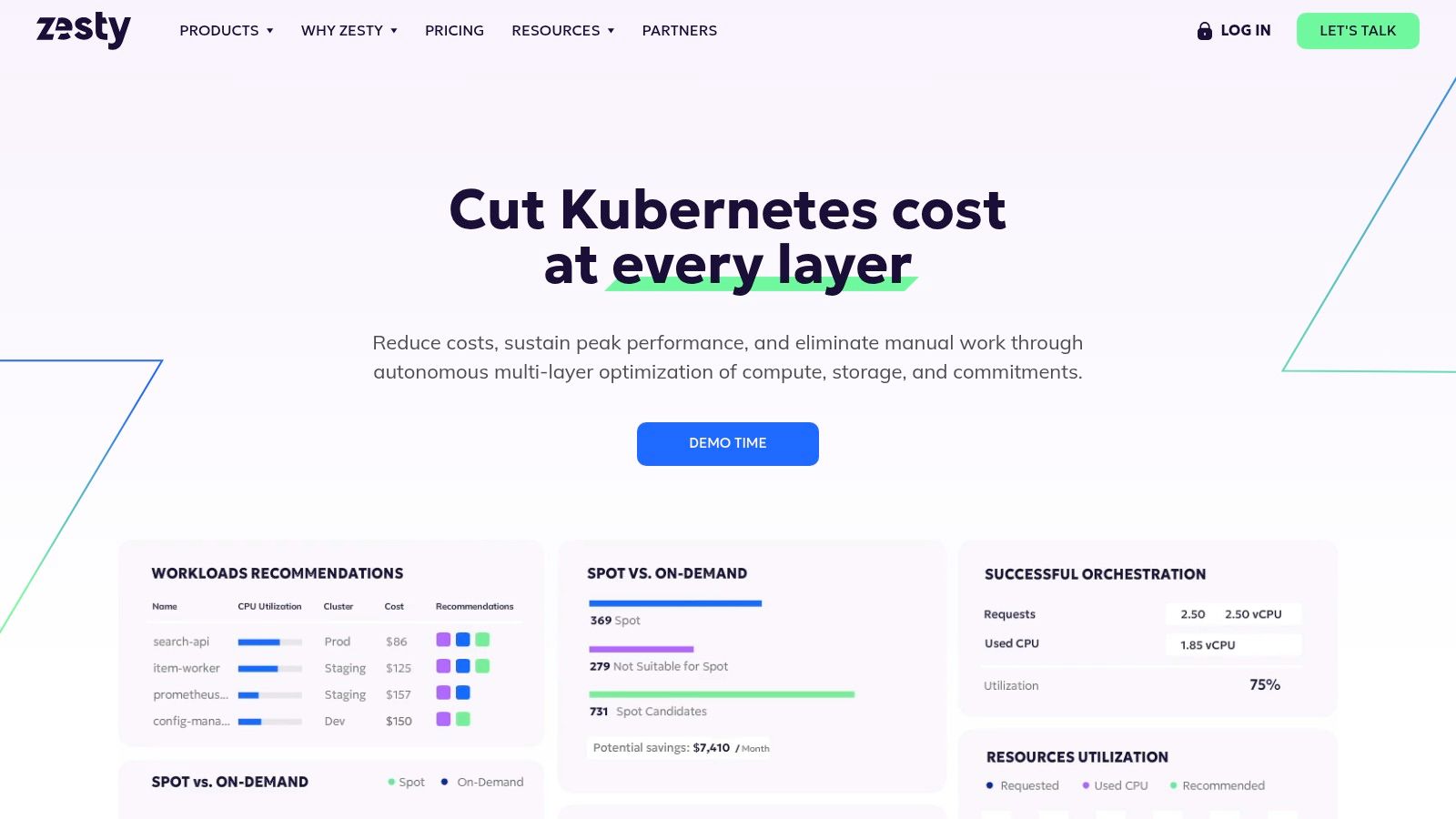
The platform's core value proposition is its "don't save, don't pay" pricing model. Zesty takes a percentage of the net savings it generates, which aligns its success directly with the customer's cost reduction. This model, combined with a savings guarantee that promises to reimburse any net losses, significantly lowers the barrier to entry for organizations hesitant to commit to long-term contracts for optimization software. This makes it an excellent choice for teams that want to immediately improve their commitment coverage and savings without dedicating engineering resources to analyzing usage and managing a complex RI/SP portfolio.
IBM Apptio Cloudability
IBM Apptio Cloudability is an enterprise-grade cloud financial management platform designed for large, complex organizations with mature FinOps practices. It excels at providing deep visibility and granular control over multi-cloud spending, with a strong focus on AWS. The platform's core strength lies in its ability to allocate fully burdened costs, establish robust governance, and manage sophisticated chargeback/showback models, making it a go-to choice for enterprises managing significant cloud budgets.
Cloudability provides the comprehensive data and workflows necessary for a centralized FinOps team to drive accountability across business units. Its powerful reporting and analytics engines allow teams to track unit economics and KPIs, moving beyond simple cost reporting to true value optimization. For organizations aiming to implement sophisticated financial controls, exploring FinOps best practices can provide a solid foundation for leveraging such a powerful tool.
VMware Aria Cost (powered by CloudHealth)
VMware Aria Cost, widely known by its former name CloudHealth, is a comprehensive multi-cloud cost management and optimization platform. It caters primarily to large enterprises and Managed Service Providers (MSPs) that require deep governance capabilities and granular visibility across complex environments. The platform stands out for its sophisticated policy engine, which allows FinOps and platform teams to automate cost control actions, enforce tagging compliance, and set budget alerts with a high degree of precision.
As one of the most mature players in the market, it offers robust features for managing AWS Savings Plans and Reserved Instances, along with specialized capabilities for Kubernetes cost allocation. This focus on enterprise-grade governance makes it a powerful AWS cost optimization tool for organizations needing to enforce strict financial controls across multiple business units or client accounts. The platform’s long track record and extensive ecosystem provide a level of assurance often required by large, regulated industries.
nOps
nOps is a FinOps platform that combines detailed cost visibility and analysis with powerful, results-based automation add-ons. It stands out by offering a simplified, fixed-fee pricing structure for its core platform, making it easier for teams to budget for cost management tooling. This approach is particularly appealing for Managed Service Providers (MSPs) and businesses looking for predictable expenses while gaining control over their AWS spend. The platform is designed for rapid onboarding and is available directly through the AWS Marketplace.
The platform’s core strengths lie in cost allocation, forecasting, and anomaly detection, providing a solid foundation for any FinOps practice. Where it differentiates further is with its optional "Optimize" modules, which tackle specific, high-impact areas like automated commitment management (Savings Plans and RIs), EKS and storage optimization, and resource scheduling. This modular approach allows organizations to start with visibility and add automation capabilities as their needs mature.
Harness Cloud Cost Management
Harness Cloud Cost Management extends beyond typical visibility tools by deeply integrating cost data into the software delivery lifecycle. It’s designed for engineering-centric organizations that want to attribute cloud spend directly to specific deployments, features, and services. By connecting cost to the CI/CD pipeline, it empowers developers to understand the financial impact of their code changes, shifting cost accountability left and embedding FinOps principles directly into their workflows.
The platform's strength lies in its ability to provide granular context. Instead of just showing that an EKS cluster's cost has increased, Harness can correlate that spike with a specific microservice deployment or a newly enabled feature flag. This direct link between action and cost is invaluable for engineering teams, making it a powerful choice for organizations already invested in or considering the broader Harness ecosystem for software delivery. This focus on developer experience makes it a standout among other AWS cost optimization tools.
CloudZero
CloudZero positions itself as a cost intelligence platform, shifting the focus from simple cost reporting to providing actionable business context. Its core strength is mapping cloud spend to specific business dimensions like individual customers, product features, or development teams. This approach allows organizations to calculate precise unit costs, such as "cost per customer" or "cost per transaction," which empowers engineering and product teams to make data-driven decisions about architecture and feature development.
Unlike many aws cost optimization tools that focus solely on infrastructure metrics, CloudZero translates technical spend into a language that resonates with finance, product, and leadership. By integrating anomaly detection, it proactively alerts teams to unexpected cost spikes, helping prevent budget overruns before they escalate. This focus on business-level metrics and rapid time-to-value makes it a powerful tool for organizations aiming to foster a culture of cost accountability across different departments.
Choosing the Right Tool for Your Needs
The journey to cloud cost efficiency begins with visibility. You cannot optimize what you cannot see. This is where tools focused on reporting and cost allocation, like AWS Cost Explorer or more advanced platforms, provide the foundational layer. They help answer the fundamental question: "Where is our money going?" Once you have that visibility, you can move to the next logical step: taking action.
This action-oriented phase is where the different categories of aws cost optimization tools truly shine. For immediate, high-impact savings, focus on the low-hanging fruit. Implementing a scheduler to power down idle non-production resources is often the quickest and easiest win. For sustained, architectural efficiency, leverage rightsizing and instance modernization tools. AWS Compute Optimizer provides a great starting point with data-backed recommendations. For maximizing commitment discounts, automated platforms are indispensable. They take the complex, high-stakes guesswork out of managing your commitments.
Selecting a tool is only half the battle; successful implementation is what drives results. Don't underestimate the need for internal buy-in and process integration. When you introduce a new tool, it must become part of your team's standard operating procedure. Start small, perhaps with a single team or application, and demonstrate clear ROI. Use these early wins to build momentum and champion a broader rollout across the organization.