Deidentified Data: Techniques, Laws, and Real-World Use
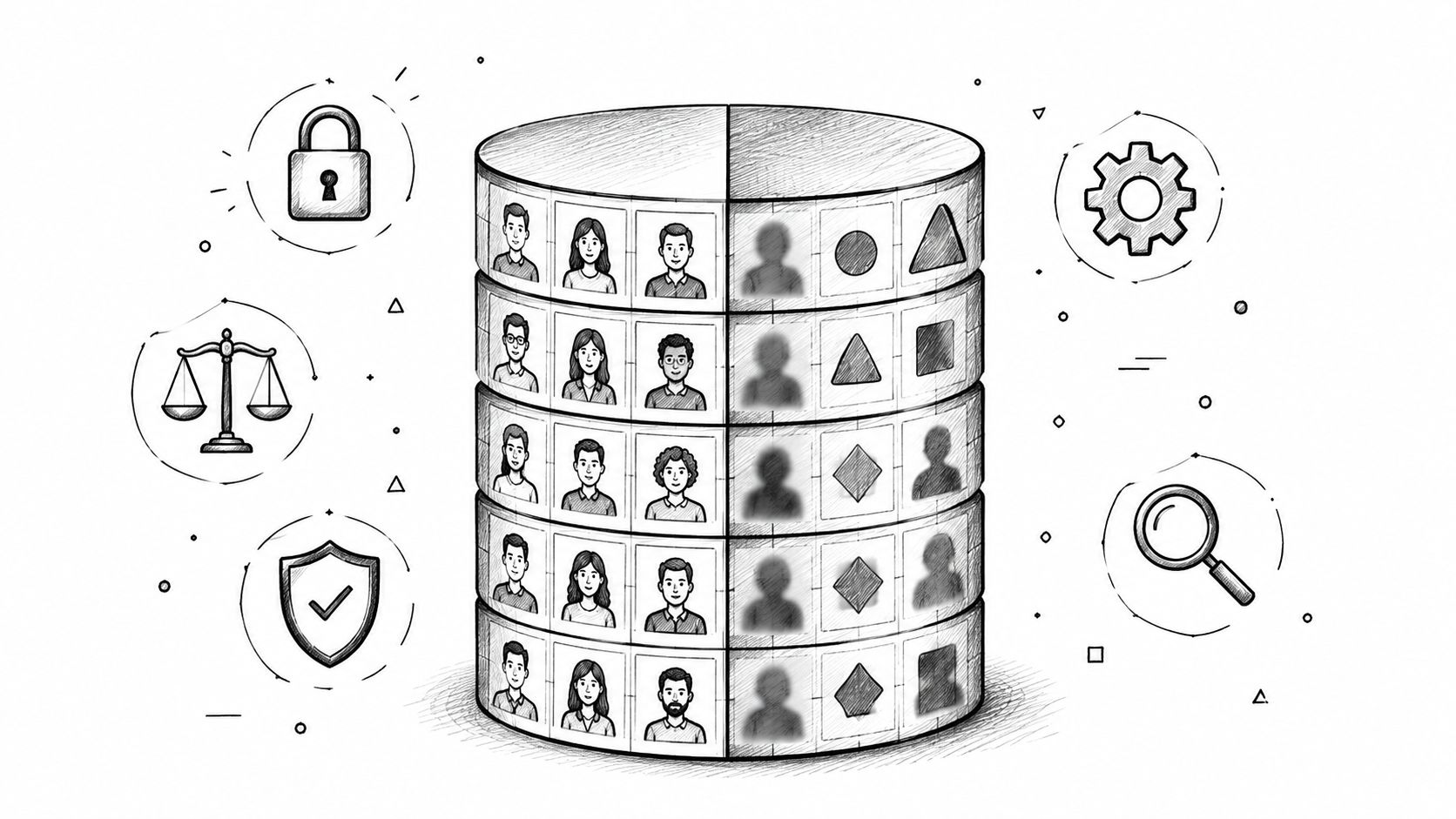
Deidentified data reduces linkage to a person or organization while preserving analytical value. Anonymized data aims to make re-identification impossible, which is a much stricter bar and is not the same thing.
If you're preparing logs, patient records, or customer tables for testing, analytics, or partner sharing, the hard part isn't removing a name field. It's deciding whether the remaining fields still let someone reconnect the record to an individual later. That's why the core effort sits in governance, technical transforms, and release controls, not just preprocessing.
Callout for teams that need a repeatable workflow: use Server Scheduler to keep your non-production systems on a predictable schedule while you build and validate deidentification steps, so data handling and infrastructure changes stay disciplined instead of becoming late-night manual work.
Table of Contents
What Deidentified Data Means in Practice
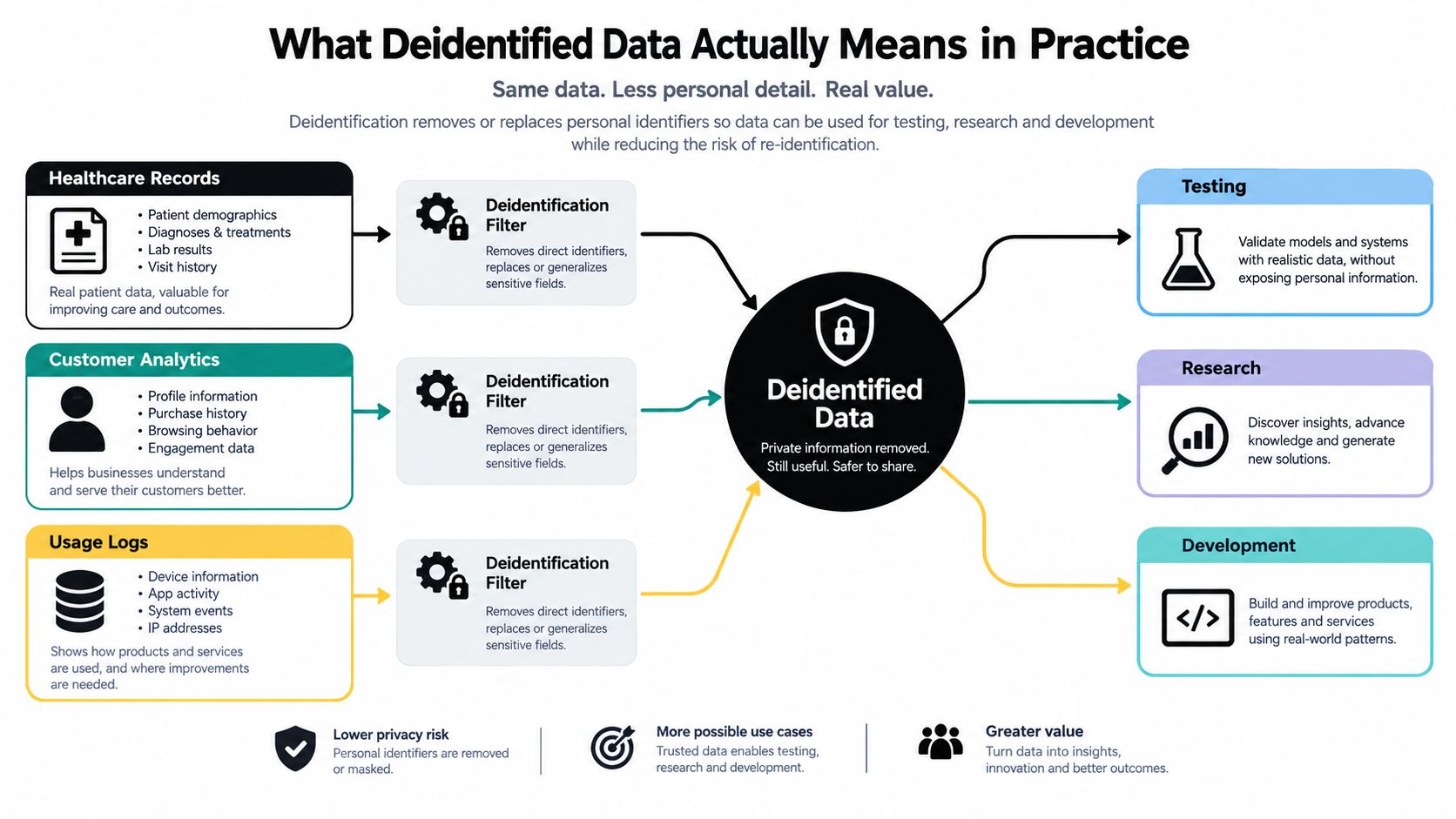
A platform team exports usage logs on Friday afternoon. A product analyst wants them in a sandbox, a security engineer wants them for incident review, and a data scientist wants them for model development. Removing emails and user IDs sounds simple, but the shared file can still expose people through dates, location, job role, rare events, or combinations that make a record unique. Deidentification reduces that linkage while keeping the dataset useful, and the U.S. Census Bureau and NIST framing of deidentification is a good reminder that the goal is risk reduction, not a guarantee that risk disappears.
What gets transformed, not just removed
The practical mistake is treating deidentification like a delete button. In practice, teams remove direct identifiers, generalize or transform quasi-identifiers, and sometimes generate synthetic data, because linkage risk usually comes from combinations rather than names alone. That matters for cloud and infrastructure teams because the decision happens before datasets are copied, shared, tested, or moved across environments.
Practical rule: if a table can still be joined back to a person through common attributes, it is not “safe” just because the name column is gone.
Deidentified data is a governance control as much as a technical one. Access controls, encryption, monitoring, and retention policies still matter, because deidentification does not replace them. It changes what is reasonably exposed if the data leaves the original boundary.
An internal audit trail also matters here, especially when teams need to show who transformed what and when. A useful reference point for that operational discipline is audit trail management, because auditors usually want evidence of the path, not just the intention.
Deidentified Data Versus Pseudonymized and Anonymized Data
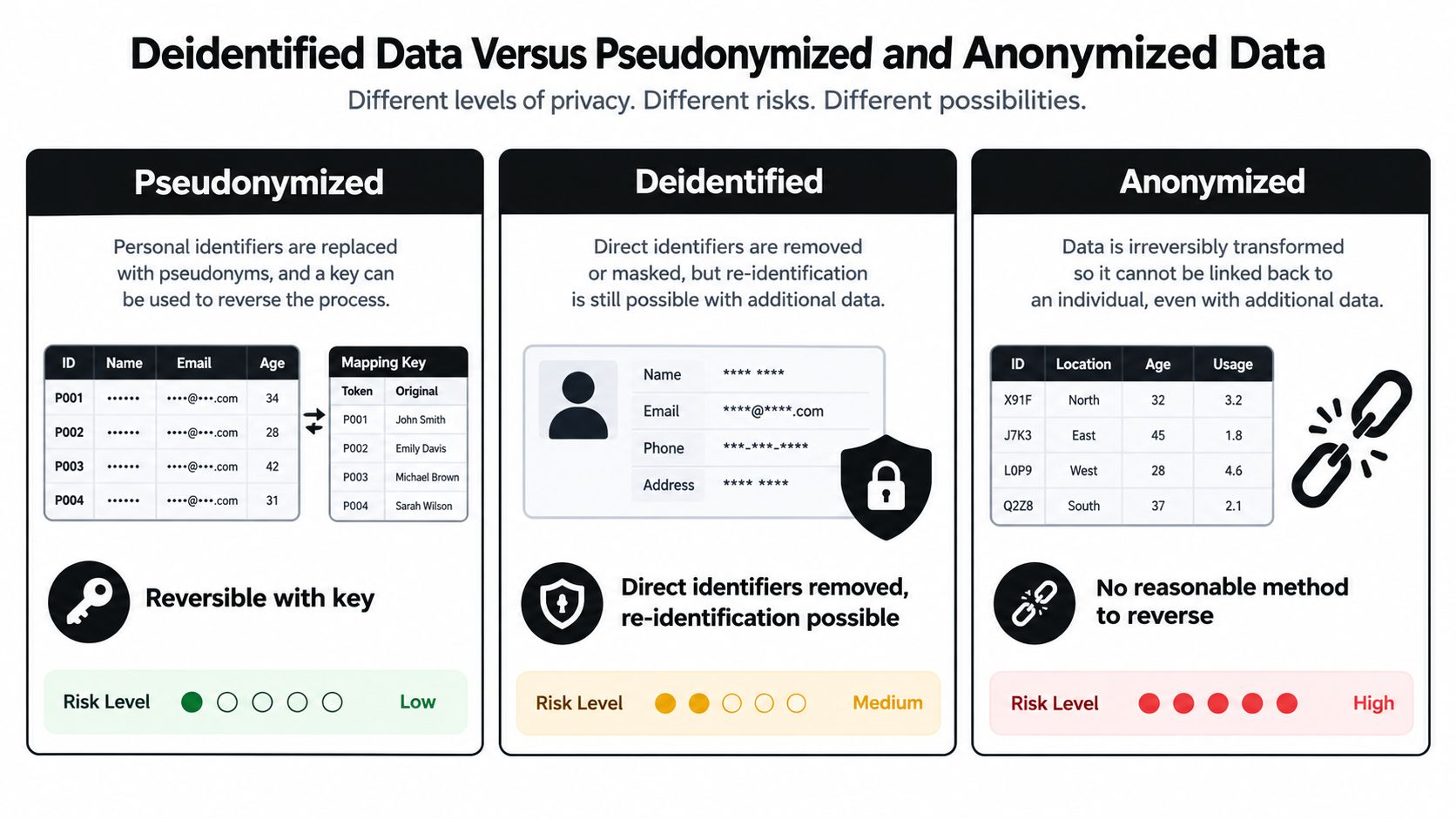
A production team can strip names from a dataset and still miss the underlying risk. Pseudonymized data replaces direct identifiers with codes or tokens, but the mapping can still exist elsewhere, so the record often remains personal data under GDPR-style regimes EDPB guidance. Anonymized data is a different outcome, because the link to a person must be unusable in practice, not just hidden from view.
The legal boundary is the engineering boundary
Under GDPR, pseudonymisation lowers linkability, but it does not remove personal-data obligations. The Irish Data Protection Commission says anonymisation must irreversibly prevent identification, and the original information should be securely deleted once anonymisation is complete Irish DPC guidance. The UK ICO also treats “de-identified” as a practical category, which means a dataset can still fall under regulation if realistic methods could re-identify it ICO guidance.
That is why infrastructure teams need to treat classification as an ongoing control, not a one-time transformation. A release that looks safe in a staging export can become risky once it is joined with logs, customer tables, or other retained datasets. The operational question is whether the data still supports a plausible path back to a person.
| Regulatory Frameworks for Deidentified Data | Key Requirement | Data Classification After Transformation |
|---|---|---|
| HIPAA Safe Harbor | Remove specified identifiers | Deidentified only if the standard is met |
| HIPAA Expert Determination | Document very small re-identification risk | Deidentified with statistical justification |
| GDPR | Pseudonymisation still leaves personal data in scope | Usually still personal data |
| UK ICO guidance | Assess realistic re-identification methods | Depends on surrounding data and access |
| Irish DPC guidance | Irreversible prevention of identification | Anonymized only if reversal isn't plausible |
What engineers should document
Document the classification, the transform used, and the residual-risk assumption. If quasi-identifiers are still meaningful in context, the label does not hold up.
Pair that documentation with least-privilege permissions as described in role-based access control, since classification without enforced access is indefensible. Auditors usually want to see who could reach the data, who changed it, and what controls blocked unnecessary exposure. A tokenized table with an intact mapping file is still personal data; a documented, mapping-free release with justified residual risk is what survives an audit.
Key Laws and Regulatory Requirements for Deidentified Data
A hospital analytics team can remove obvious identifiers and still leave a dataset that regulators would treat as personal data. The legal issue is whether the remaining fields, the surrounding controls, and the intended use still leave a realistic route back to a person.
HIPAA gives teams two common paths. Safe Harbor means removing specified identifiers. Expert Determination requires documented statistical or scientific reasoning showing that re-identification risk is very small. The choice is operational. If your team cannot defend the residual risk with evidence, the method is weak for regulated healthcare data.
Deidentification is not a one-time scrub before export. Regulators look at the whole process. Recent analysis of deidentified-data governance describes the need for safeguards against reidentification, business rules that prohibit it, controls against accidental release, and no attempt to reidentify people. Access policy, contracting, and release procedure belong in the same control set as the transformation itself 2025 review of deidentified-data governance.
How to choose the right path
Use Safe Harbor when the data can be reduced to the required shape without destroying the use case. Use Expert Determination when the data only stays useful if you retain structure such as dates, cohorts, or analytical fields that a rigid identifier-removal checklist would overstrip. In both cases, the data owner needs a clear record of what was removed, transformed, or retained.
The auditor's real question is whether someone with realistic auxiliary data could reconnect the dots.
Cross-border work makes the classification harder. Under GDPR, pseudonymized data still counts as personal data, so lawful basis, security controls, and processing limits still apply. UK guidance from the ICO and Irish guidance from the DPC both push the same practical point, the dataset's status depends on the surrounding environment, not just on whether obvious identifiers are present.
What compliance teams will ask for
Expect questions about source systems, legal basis, transformation logic, release approvals, monitoring, and whether any original mappings were retained. If those answers live in email threads, the process is too weak. Compliance wants evidence, not intent.
How SourceX Can Help
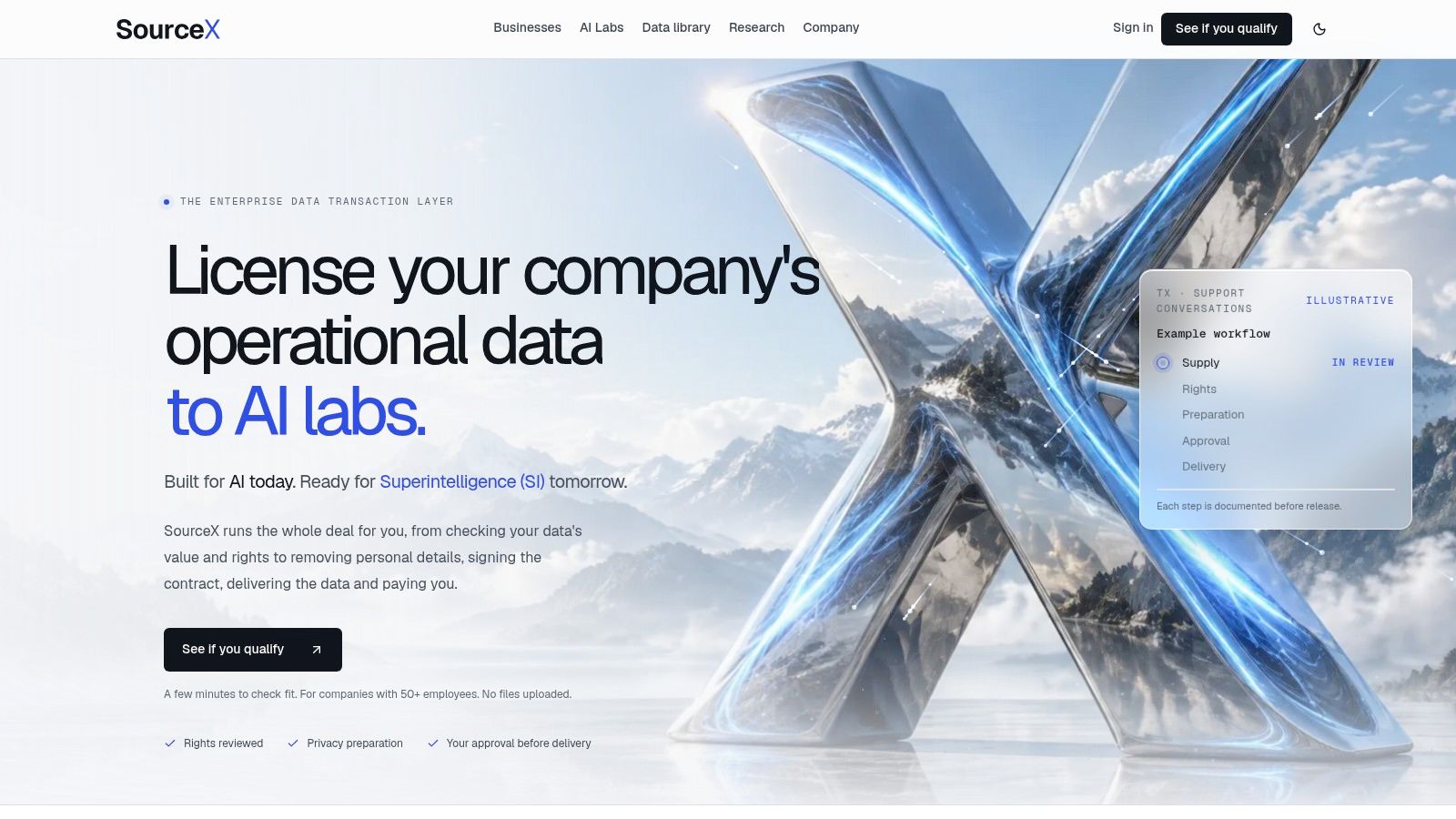
When deidentified operational data is being prepared for external licensing, SourceX is designed to keep the supplier in control of the process. It's an enterprise data transaction layer that standardizes sourcing, rights validation, deidentification, contracting, delivery, and payment inside one controlled workflow, so nothing moves until the supplier approves each step.
For teams trying to understand how that looks in practice, deidentified data is useful because it connects privacy preparation with rights review and buyer evaluation. That matters when your challenge isn't just masking fields, but deciding whether a dataset is even licensable, what scope is allowed, and how to package it without creating avoidable risk.
Where it fits
SourceX is strongest when a company has messy operational exports spread across support, sales, engineering, or document systems, and needs a private inventory before any buyer conversation begins. It also helps when provenance is a problem, because the workflow records the system of origin, permissions, and intended use before release. That's a better fit than ad hoc file sharing if legal review, buyer negotiation, and packaging all need to happen together.
The platform is not a substitute for your own classification and deidentification judgment. It's the coordination layer around that judgment, which is why it's useful for teams that need rights-cleared data licensing rather than a simple masking tool.
Technical Methods for Deidentifying Data
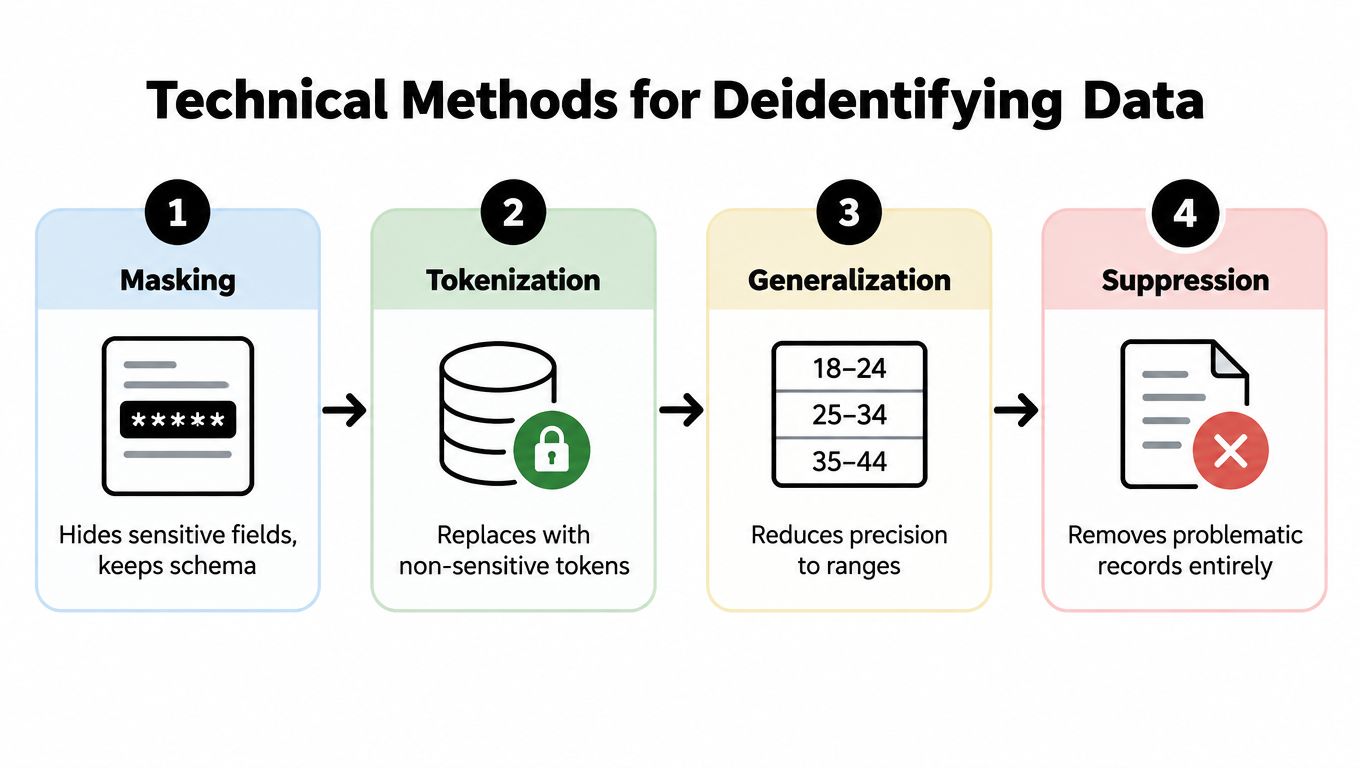
A dataset can look deidentified on export and still create risk once it is joined, queried, or reused in another workflow. That is why the method matters less than how it holds up under real operations. Masking hides sensitive fields while keeping the schema usable, tokenization replaces identifiers with non-sensitive tokens, generalization broadens exact values into ranges, and suppression removes the highest-risk rows or fields. Teams often combine them because each one reduces a different kind of exposure.
Matching the method to the dataset
Tokenization works when downstream systems need referential integrity without revealing the original identifier. Generalization fits dates, geography, and age bands when exact precision is not needed. Suppression is blunt, but it is often the right call for rare outliers that would stand out in linkage tests.
Before generalizing or suppressing quasi-identifiers, verify how tables will be combined. A reference like how to join 3 tables in SQL helps standardize the join logic you are testing against, especially when the same person or event appears in multiple exports.
Differential privacy and synthetic data belong in the same decision set, but they solve different problems. Differential privacy limits what a query or release can reveal. Synthetic data creates records that mirror statistical patterns without containing the originals. Neither one removes operational risk on its own. If the dataset has high-dimensional behavior patterns or repeated tokens, traditional reduction methods can still leave a distinctive fingerprint.
If downstream use depends on exact sequences, fine-grained timestamps, or rare combinations, start with utility requirements, then work backward to the least risky transform.
The mistake is choosing the lightest transform that passes a policy checklist. The better test is whether the transformed data still behaves like the source for the intended use case, and whether the controls stay in place after the first export.
Reidentification Risks and How to Measure Them
A transformed dataset can still be exposed. Auditors and security reviewers focus on reidentification because the risk changes with the attacker's outside data, the dataset's size, and which quasi-identifiers still work in combination. A systematic review of reidentification attacks reported an average success rate of approximately 26%, with a 95% confidence interval of 4.6% to 47.8%. Health-data attacks in that review averaged 34%, and one health-data attack against records meeting recognized HIPAA deidentification standards succeeded on 0.013% of records. The same review estimated HIPAA Safe Harbor demographic sharing risk between 0.01% and 0.19%.
What to measure before release
Use the attacker's view, not the internal approval view. Check what external data is available, how many quasi-identifiers matter, and whether later releases will make linkage easier. A 2025 study of a public dataset found that more than 45% of records could be reidentified when an adversary knew seven quasi-identifiers, more than 9% when four attributes were known, and the estimated probability of correct reidentification reached 0.35 under a stronger knowledge scenario. That is why “anonymous” is too coarse a label for release decisions.
A practical evaluation loop
- Classify the fields. Separate direct identifiers, quasi-identifiers, and rare attributes.
- Model the attacker. Define which public sources, partner data, or prior exports could be combined with the release.
- Test linkage. Run joins against plausible external information and review collision rates.
- Review the result. Confirm the dataset still supports the intended analysis.
- Reassess over time. New releases and new data sources change the risk profile, so the review cannot stop at first export.
- Log every change. Keep a defensible trail of what changed, who approved it, and why. See audit log examples for what that trail should contain.
The operational gap is often here. A dataset can pass an initial risk check and still become harder to defend if contracts weaken, access widens, or monitoring is missing. Reassessment should sit with the data owner and security reviewer, with a fixed cadence tied to each new release and each material change in upstream data.
Implementation Checklist for Engineers
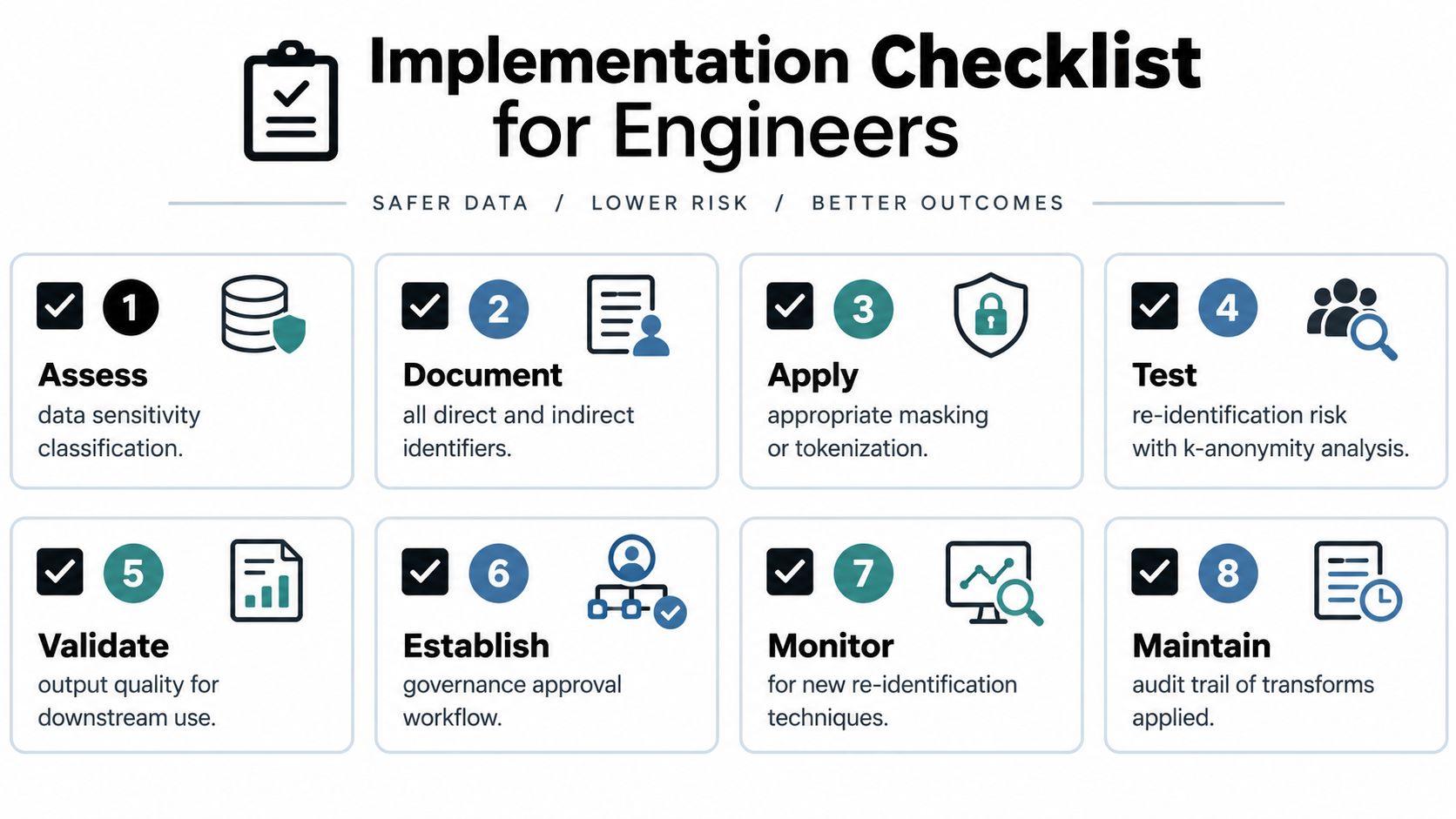
Start with the use case, not the tool. If the data is going to a test environment, a partner, or a research workflow, classify the rows and fields before anything is copied. Then document direct identifiers, indirect identifiers, and the analysis you need to preserve.
What a usable workflow looks like
- Assess sensitivity. Mark what is regulated, what is operationally sensitive, and what is publicly safe.
- Choose the transform. Use masking, tokenization, generalization, or suppression based on the downstream task.
- Check the join risk. Review whether quasi-identifiers still point to a person.
- Approve release. Make sure legal, security, and data owners sign off before sharing.
- Log every change. Keep an audit trail of what was transformed and why.
Keep access controls, retention, and monitoring in place after release. Deidentification doesn't cancel those controls, it works alongside them. If your team treats the transformation as the finish line, the process is incomplete.
Real-World Use Cases and Recommended Tools
Healthcare teams rely on deidentified records for retrospective studies, model development, and cross-site collaboration. Government teams publish statistical datasets while trying to avoid individual disclosure. Enterprise analytics teams use deidentified customer behavior data to compare segments, measure product usage, and share insights across departments. The method changes with the job, but the principle stays the same, reduce linkage without wrecking utility.
For engineering workflows, the best tools are the ones that fit into existing pipelines, CI/CD checks, and governance approvals. Tokenization is useful when systems need stable joins. Differential privacy is stronger when query disclosure is the main risk. Synthetic data is often the better choice when teams need broad realism without exposing source records. The practical answer is usually a mix, not a single technique.
If your team also manages data collection or enrichment pipelines, a reference like how to join 3 tables in SQL can help standardize transformations before anything sensitive is moved downstream. For teams building automated collection workflows, data scraping with Python is the kind of operational discipline that should be paired with privacy review from the start.
The cleanest takeaway is simple. Deidentified data works when technical transforms, legal classification, and release governance move together. It fails when teams treat it as a quick preprocessing step and assume the hard part is over.
If your team is standardizing data workflows across cloud environments, pair deidentification reviews with disciplined automation and audit-friendly scheduling in Server Scheduler so releases, tests, and maintenance happen predictably instead of ad hoc.